
Prune Cake with Walnuts
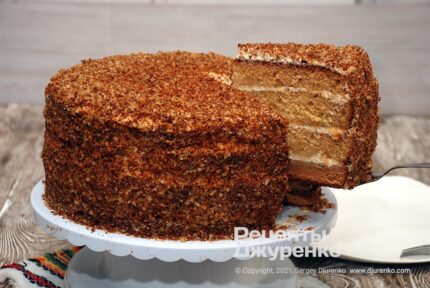


Ingredients
5.6 kg (approx.)
- For the sponge (for three bakes)
- Eggs 21
- Sugar 600 g
- Honey (liquid) 12 tbsp
- Flour 5 cups (650 g)
- Margarine or butter 150 g
- Lemon zest 3 tbsp (18 g)
- Baking powder 1 sachet (for 1 kg of flour) or 1.5 tsp baking soda with lemon juice
- For soaking
- Water 500 ml
- Brandy or cognac 75 ml (optional)
- Honey (liquid) 3 tbsp
- For the cream
- Condensed milk (boiled) 1 can
- Cream cheese 1 kg
- Sweet prunes (pitted) 350 g
- For the topping
- Walnuts (shelled) 350 g
Step-by-step recipe
Preparing and baking the sponges
The cake is made in three stages, which can be done in parallel. The homemade sponge batter – one of the simplest – is no trouble to bake. From the ingredients listed you need to bake three identical sponges, so divide all the sponge ingredients into three parts: for each bake, 7 eggs, 200 g sugar, 4 tbsp honey (85 g), 50 g butter and 1 tbsp zest (6 g).
Prepare the ingredients in advance. Take the eggs out of the fridge so they come to room temperature; this is the most important thing. Boil the can of condensed milk: the can must be completely covered with water. Simmer gently for about 2 hours, topping up with boiling water, then cool without opening. The condensed milk should turn light brown. Melt the butter or margarine, but don’t overheat it.

Beat the eggs with the sugar. In the mixer bowl combine 7 eggs and 200 g of sugar and beat with the mixer until you get a fairly thick, stable foam; the mass will increase in volume 2-3 times. The egg foam is the basis of the batter.

Add the zest, honey and butter. Using a fine grater, grate 1 tbsp of lemon zest (6 g) into the egg foam and mix. Add 4 tbsp of liquid natural honey, linden or wildflower, and mix with the mixer: the batter will rise slightly more, which always happens when honey is added. Pour in the melted fat and mix.
There’s no need to add flavorings or vanilla; the cake will be fragrant thanks to the honey and the smoky aroma of the prunes.

Add the flour. Sift the flour in advance, about 1.5 cups for each bake, and keep a little extra just in case. Mix the portion of flour with baking powder, about a third of a sachet meant for 1 kg of flour. You can use 0.5 tsp of baking soda (3 g) slaked with lemon juice, but the rise will be weaker, and there may be an aftertaste if you get the proportions wrong. Add the flour to the honey batter and mix; the mixture will settle a little, and the consistency is close to thick honey.

Bake the sponge in an oven preheated to 180-190°C. The springform pan (ours is rectangular, 20×30 cm) doesn’t need greasing, but it’s worth lining with baking paper. Pour the liquid batter into the pan and put it in the oven.

Usually this amount of batter is fully done in 30 mins. Check with a toothpick: if no batter sticks to the wood when you pierce it, the sponge is ready. Carefully take the pan out of the oven and move the sponge to a wooden board to cool. Bake the other two sponges the same way.


Soaking syrup, layers, topping and cream
We soaked the cake with an aromatic syrup with a little alcohol. You can make an alcohol-free syrup if that’s not acceptable for some reason. It’s best to prepare the syrup right away so it has time to cool well.
Make the syrup. In a small saucepan bring a mixture of 0.5 l of water and 75 ml of brandy or cognac to a boil. Let it boil for 2-3 mins and turn off the heat. When the syrup has cooled a little but is still hot, add 3 tbsp of honey (65 g), stir and cool completely to room temperature.

Cut the sponges into layers. All three sponges must be cool. With a knife, cut off the top and bottom crust and the sides, which are usually dark and glossy. They are not needed in the layers, but they’re perfect for the topping. Cut each sponge into two layers to get six. They can be stacked on top of each other without sticking.

Prepare the topping. Toast the walnuts in a dry skillet over medium heat or in the microwave until they smell pleasantly “nutty”. Grind the nuts to crumbs in a blender and transfer to a bowl. In the same blender grind all the sponge trimmings and mix the crumbs with the nuts. Set the topping aside for now.

Make the cheese cream. Put the cream cheese in the mixer bowl. You can always buy “cream cheese” in stores, a natural dairy product with different fat levels. Philadelphia or a similar cream cheese also works great. You need a lot of it, as the cake will be big.

The boiled can of condensed milk must cool. The contents may be thick or slightly runny, which doesn’t matter. What matters is that the condensed milk is light brown and tastes like toffee candies, only liquid. Mix the cream cheese and condensed milk with the mixer until smooth and put in the fridge.


How to assemble the prune cake
Prepare the prunes and a plate. Cut the prunes into small pieces, each into four. Also make sure there are no pits. Pick a plate of suitable size for assembling the cake; its shape doesn’t have to match the sponge layers.
Soak the layers and spread them with cream. Put the first layer on the plate and drizzle it with the cooled syrup. The sponge should be moist but not dripping. Divide the syrup roughly equally among all six layers.

Mentally divide all the cream into seven parts: one for each layer and one more for coating the sides of the cake. With a spatula, spread the cream generously and evenly over the layer. There’s no need to level the cream right at the edges of the layer, as any gaps will be filled in from the sides.

Decide how many layers of cream will have prune pieces. We did every other one. You can do all the layers or only two, as you like. Arrange the prune pieces over the cream and put the next layer on top. After that it’s all the same: soak the layer, spread with cream, arrange the prunes.

Coat the cake with cream. Spread cream on the top layer. Spread the last portion of cream over the sides, filling the gaps between the layers. Shape an even cake with no “waves” on its surface and no sponge edges sticking out. A spatula makes this easy.

Cover the cake with the topping, a mixture of toasted walnuts and sponge crumbs. It sticks to the cream wonderfully and stays put. Take crumbs by hand and press them onto the cream, top and sides. That way the whole cake is covered in a shaggy “coat” of crumbs.


Serving
Let the cake rest and soak in the cold, ideally overnight. The cake is big, meant for a celebration and for guests, so it’s best made the day before. Put it in the fridge, and shortly before serving take it out and let it warm up a little.
Cut the cake into pieces with a large knife. You don’t need to cut tall, thin slices, which are hard to put on a plate. Cut large cubes; inside, the cake is layered and fairly uniform.

If you like, decorate the dessert with cream flowers or prune halves with nuts tucked inside. Serve the cake as a festive dessert; I’m sure it will be the highlight of the table. I think a cake weighing up to 6 kg can feed two dozen guests. With strong tea or cappuccino it will be incomparable.

Calories and macros
299 kcal
100 g
- Protein6.5 g9% of kcal
- Fat15.3 g46% of kcal
- Carbs33.7 g45% of kcal
Calculated from the recipe ingredients, excluding salt and spices. Data: USDA and Matvaretabellen.
 Silicone cake panAliExpress
 Piping bag with nozzlesAliExpress
 Kitchen scale up to 5 kgAliExpress
 Pull chopper for garlic and onionAliExpress
 Oil sprayerAliExpress
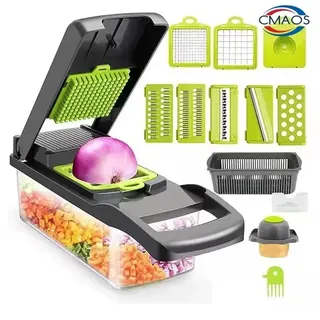 Vegetable chopper with handleAliExpress