
Lemon Cake
Long ago, when I was at school, I loved treating myself at the canteen during the “big” break to apple juice, which went wonderfully with a portion of lemon cake, or lemon pastry. Hard to say whether it was a cake or a pastry; most likely a large cake was cut into rectangles and called a lemon pastry.
Surprisingly, in Latin the word tōrta means “round bread”. Still, a cake is first of all a dessert. As a rule, it is several pre-baked layers soaked in cream and decorated on top with cream, candied fruit, chocolate or glaze.
Lemon cake, or lemon pastries, is an affordable and very popular treat and, notably, quite simple to make. Like most cakes, it consists of several layers of sponge spread with a lemon cream based on egg white. Almost the same cream is used for the meringue of a lemon meringue pie.
Cakes are traditionally considered to be round. However, as is much more convenient in factory production, many cakes are rectangular and cut into pieces like pastries. This is how lemon cake is made: a large rectangular cake is cut into portions and served as lemon pastries, individual confections.
By and large, lemon cake is simple to make and does not require a pastry chef’s skills. It is rather a simple home version with minimal decoration: just baked sponge and lemon egg-white cream. I confess, the taste of childhood, even better.
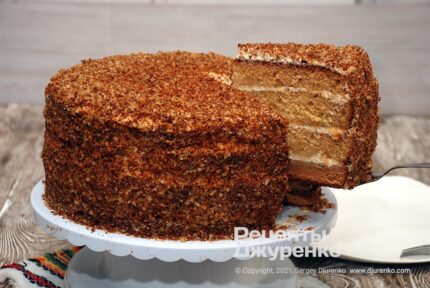



Ingredients
8 servings
- For the sponge
- Butter 150 g
- Sugar 0.5 cup
(90 g) - Eggs 6 (whites of 5 go into the cream)
- Lemon 1 (zest for the batter, juice for the soda and cream)
- Baking soda 1 tsp
(6 g) - Vanilla a pinch
- Wheat flour 2 cups
(260 g) - For the cream
- Egg whites 5 (from the eggs for the sponge)
- Sugar 1 cup
(180 g) - Instant gelatin 10 g
- Water 100 ml (50 ml for the gelatin and 50 ml for the syrup)
- Lemon juice 1-2 tbsp (from the same lemon)
- Salt a pinch
Step-by-step recipe
Preparation
Making a lemon dessert at home is as easy as whipping the cream for tiramisu. Baking a good sponge and preparing the egg-white cream with lemon is really all there is, two parallel processes. The lemon pastries or cake then need to soak and chill for a while. In total you need 6 eggs and 1 lemon.
Take the eggs and butter out of the fridge in advance so they come to room temperature.
Break 5 eggs and separate the yolks from the whites, putting them in different cups or bowls. Leave one egg whole.
Put the whites in the fridge; they will be used for the cream that coats the cake. The yolks are needed for baking the sponge base.
Using a fine grater, remove all the zest from a small lemon. Squeeze the lemon juice into a cup and strain it.


Sponge
You will need a stand mixer to prepare the sponge batter.
Cut the softened butter into the mixer bowl. Add 0.5 cup sugar (90 g), a pinch of vanilla, the egg yolks and one more egg, yolk and white together.

Beat thoroughly with the mixer until smooth. Add all the lemon zest and keep mixing. Thanks to the high amount of zest, the sponge will have a strong aroma.

“Quench” 1 tsp baking soda (6 g) with lemon juice and mix it into the beaten yolks and butter.
The sponge needs a leavening agent. Usually a store-bought baking powder containing ammonium carbonate is used. Since we are making a lemon dessert, it is better to quench the soda with the lemon juice squeezed earlier. You can take more juice than needed; the full lemon flavor will show itself in the cake.

Keep mixing the sponge batter while adding the flour. You may not need all the flour, or you may need to add more, depending on the situation. The final consistency should be like very thick honey; it should spread like pâté or jam on fresh bread.
The batter must not spread or drip off the mixer, and the mixer should still be able to stir it at medium speed, though with effort. The batter should be much softer than strudel dough.


Line a rectangular baking sheet with baking paper and spread all the batter onto it.
There is no need to grease the paper or dust it with flour. The sponge batter contains a lot of butter, so the paper will not stick to it.

With a spatula, smooth the batter over the paper in an even layer no more than 12-15 mm thick, shaping it into a rectangle.
The edges will be trimmed later, so there is no need to make them perfectly geometric. Remember that the thickness of the sponge layer determines the thickness of the lemon cake.

Bake the sponge in an oven preheated to 200°C for roughly 15-20 mins, depending on the thickness of the batter and your oven. The batter should set and start turning dark yellow, even coffee-colored.

Take the baked sponge out of the oven and let it cool completely.
Flip the sponge over and peel off the baking paper; it comes away beautifully, in one motion.

Put the cooled sponge on a board and trim the edges with a knife to make a neat rectangle. It is worth taking care with the geometry so that the cake or pastries do not end up lopsided.

Put the trimmed edges of the sponge in a blender and grind them to crumbs. These crumbs will be sprinkled over the cake.

Cut the sponge with its neat edges exactly in half and put the two pieces together like a sandwich to make the cake blank.
Cut the two sponge sheets into portion-sized pieces with a knife right away. How many pastries you get is up to you. The given amount of ingredients makes 4 to 8 pastries of equal size.
Cut them now, whether you are making a cake or pastries. Once the lemon cake is coated with cream, it will be very hard to cut into portions. Lemon cream is so delicate that, however sharp the knife, the sponge layers will deform the cream layer as you cut, and it will squeeze out.
Important: the cut paired pieces of sponge must not be shuffled later or swap their partners, otherwise the lemon cake will turn out uneven.


Egg-white cream
Take the egg whites out of the fridge and pour them into the mixer bowl. Set the bowl in very cold water.
Add a pinch of salt and whip the whites into a thick, dense foam.

In a cup, dissolve 10 g instant gelatin in 50 ml water.
Pour 50 ml water into a saucepan and add a cup of sugar (180 g) and 1-2 tbsp lemon juice. Put it over low heat and warm until the sugar begins to dissolve.
Use exactly 50 ml water each time: with extra water in the syrup or gelatin, the whites will turn runny once the syrup goes in.
When the first signs of boiling appear, pour in the dissolved gelatin and stir. As soon as it starts to boil again, take the saucepan off the heat.
Whisking the whites continuously, pour in the hot syrup with gelatin in a thin stream.
Everything must be done quickly. The whites will not curdle; they simply will not have time. The amounts of sugar and water are generous, so you may not need all of the mixture for the lemon cream.
The cream turns out smooth and glossy, perfectly uniform and slightly thick. Once the gelatin sets, the cream will be even firmer and the dessert will hold its shape perfectly.


Assembling the cake
Although the pieces are rectangular, it is easier to use a round cake stand, as it is simpler to spread the cream on the sponge and coat the sides.
Lay out on the stand the sponge pieces from the bottom half of the set, taking care not to mix up their places. Place them snugly against each other.

With a spatula, spread half of the cream over the sponge.

Smooth the lemon cream, keeping the sponge and cream in a rectangular shape.

Gently and without pressure, lay the top pieces of sponge over the cream one after another, without mixing up their places.

Press the top lightly so the cream squeezes out slightly at the sides of the cake. To make the cake even, you can press it with a board, which levels the height of the top sponge layer.

Spread all the remaining cream over the second sponge layer. Smooth the cream with a spatula and coat the cake with cream on all sides.

Sprinkle the cream generously with the leftover sponge crumbs.

Put the cake in the fridge until the gelatin in the cream has completely set. The minimum time is 2 hours, but the best option is to chill the lemon pastries overnight.

The finished dessert is already cut into portion-sized pastries. When serving, you only need to separate the cake into pastries with a knife, cutting through the cream only. This is easy because the sponge is already cut and the cream layer will not deform.

Serve the lemon cake at a festive table or an evening tea, whole or divided into individual pastries. As you like.
Lemon pastry is delicious with fresh apple juice, just like in childhood. Still, a tasty and healthy tea with ginger and lemon goes wonderfully with the flavor of this dessert.
PS Thanks to Yulia, my daughter, for the recipe and the tasty dessert.


Calories and macros
455 kcal
Serving ≈ 170 g
- Protein12 g10% of kcal
- Fat19 g38% of kcal
- Carbs59 g52% of kcal
100 g271 kcalProtein 6.9 gFat 11.4 gCarbs 35 g
Calculated from the recipe ingredients, excluding salt and spices. Data: USDA and Matvaretabellen.
 Silicone cake panAliExpress
 Piping bag with nozzlesAliExpress
 Kitchen scale up to 5 kgAliExpress
 Pull chopper for garlic and onionAliExpress
 Oil sprayerAliExpress
 Vegetable chopper with handleAliExpress