
Bulgarian Pork Kebab with Cheese
Back in my student days, my friends and I often dropped by the Lastochka cafe in Kyiv, above the Bolshevik metro station, for the lula kebab they made there. It wasn’t quite the real thing, but it was very tasty. Friends from the Caucasus spoke disapprovingly of the local version, yet they ate it, and with real appetite too.
Lula kebab, or simply kebab (kabab, kabob, kebap…), comes from the Persian کباب, meaning roasted meat. It is a catch-all name for a huge number of similar and not-so-similar meat dishes popular in the East, the Caucasus, Asia and the Balkans.
What we know best is shashlik, or as it is called in the East, shish kebab, cooked on skewers. In the East, cooks impress with their skill at handling meat; here, we impress with the variety of recipes. Strictly speaking, kebab is made from lamb or beef, for religious reasons. But here and in the Balkans pork is the most common choice. Poultry, fish and vegetables are used too, and there have even been tasty pike cutlets.
In most Eastern languages the word kebab comes from a term related to fire: scorched, charred, burnt. In the Middle Ages the word was adopted by many languages and came to mean pieces of meat grilled over coals. Even chicken cutlets on a grill rack are kebab too, chicken kebab. But a pork chop is a whole piece of meat.
The Balkans, Bulgaria in particular, have many kinds of kebab, and the most delicious of them is kebabche (kebabcheta in the plural). It is the first dish I order whenever I visit my friends in Bulgaria on vacation. Nothing complicated: a mix of pork and beef, cumin and savory, water. No onion. The sausages are shaped by hand and grilled over charcoal.
Then there are cevapcici, grilled sausages of ground meat (beef, pork) with onion and spices, served with white flatbread, onion and pepper.
Quite often various additions go into the kebab mince. I once ate a very good kebab with young Caucasian cheese mixed in. Or with boiled rice added to the mince, like in meatballs, but grilled over coals.
I still remember the Turkish shish kebab (şiş kebap) that I tried on the border between Turkey and Bulgaria. It was made from lamb with boiled wheat (?) added; I didn’t catch the term, they said “pirinç”. The dense mince was molded around the skewer in the shape of a sausage and grilled over coals.
Today, using the grill pan we recently bought, we decided to make a pork and cheese kebab. It is a great dish for lunch, easy and quick to make. Very tasty.


Ingredients
2 servings
- Pork 350 g
- Hard cheese 75 g
- Parsley 5-6 sprigs
- Garlic 1 clove
- Egg 1
- Spices: cumin, salt, ground black pepper, savory to taste
Step-by-step recipe
Bulgarians are great masters and inventors when it comes to cooking meat, and their kebab-making skill has always been top class. It is their national food, right after stuffed peppers and priest’s yahniya, in my opinion.

You can always make mince from whatever meat is at hand, but it won’t give you a Bulgarian-style kebab. For that you have to put in a little effort.
The pork should be somewhat fatty, ideally shoulder with a little fat. If necessary, add a bit of ground pork fat to the mince so the sausages come out soft and juicy.
Grind the pork twice through a meat grinder with a fine plate. Or even three times!

Grate the hard cheese on a fine grater or chop it any way you can.
Chop the parsley leaves very finely, preferably with a blender. By the way, you can add other aromatic herbs too: cilantro, basil, dill.
Crush the garlic with salt in a mortar.
Separate the egg white from the yolk. Only the white goes into this meat dish.
In a bowl, combine the ground pork, egg white, grated cheese, herbs and garlic. Add pepper, ground cumin on the tip of a knife and 2-3 pinches of crushed dried savory. Savory is the main spice of Balkan cuisine; Bulgarians call it “chubritsa”. It goes exceptionally well with any meat and makes the dish very aromatic.

Knead the mince very thoroughly. Work it slowly and carefully until it becomes smooth and elastic. It helps to add a little boiled water and knead once more. Sometimes dry white wine is added instead of water.
Strictly speaking, the mince is ready for frying. But it is better to let it rest in the fridge to mature. We usually make the mince in the evening for the next morning.

With wet hands, shape sausages as long as the width of your palm and as thick as a small sausage, or slightly thinner.

From here you have options.
If you have a grill in the yard, or you are getting ready for a picnic, put the pork kebabs on the grill rack and cook over hot coals until done. Usually 12-15 minutes, turning them over.
At home we used to cook on an electric grill, a technique we picked up from the Bulgarians. Recently we bought a square grill pan with a heavy, ridged bottom. It fries wonderfully, so that’s what we did.
Put the pan on the stove and heat it until drops of water hiss and evaporate almost instantly. Lay the pork kebabs on it. Place them diagonally to the ridges on the bottom, purely for looks.

Fry on all four sides in turn, 4 minutes each. That is quite enough! Turn the pork kebabs with a fork if you have no special tongs.

Put the finished kebabs on a plate and serve with spicy tomato sauce or adjika. A couple of times I have seen finished kebabs drizzled with soy sauce, which is a bit unusual for the East, but tasty, that’s true.
I don’t know whether kebabs need a side dish… Well, maybe just some fresh herbs and sliced vegetables: tomato, cucumber, pepper. And preferably fresh white bread, such as flatbread, lavash or kesra. And a glass of wine.


Calories and macros
590 kcal
Serving ≈ 170 g
- Protein43 g30% of kcal
- Fat44 g69% of kcal
- Carbs2 g1% of kcal
100 g339 kcalProtein 24.8 gFat 25.5 gCarbs 1.1 g
Calculated from the recipe ingredients, excluding salt and spices. Data: USDA and Matvaretabellen.
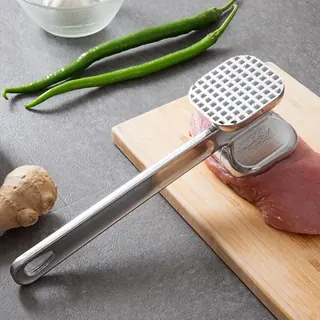 Meat tenderizerAliExpress
 Kitchen probe thermometerAliExpress
 Pull chopper for garlic and onionAliExpress
 Oil sprayerAliExpress
 Kitchen scale up to 5 kgAliExpress
 Vegetable chopper with handleAliExpress