
Ginger Cookies


Ingredients
1 kg cookies
- For the dough
- Wheat flour 0.5 kg (plus extra for dusting the table)
- Ground ginger 2 tsp (5 g)
- Butter 200 g
- Honey or molasses 5 tbsp (105 g)
- Brown or cane sugar 100 g
- Baking soda 1–1.5 tsp (6–8 g)
- Egg 1
- Allspice, cloves, cinnamon, nutmeg 0.5 tsp each
- Cardamom optional
- For the icing
- Powdered sugar as needed
- Water as needed
- Beet juice, matcha tea, blueberry juice optional, for color
Step-by-step recipe
How to make the ginger cookie dough
As I said, ginger cookies should be fragrant, so the dough needs plenty of spices. Take the butter and egg out of the fridge ahead of time so they come to room temperature.
Prepare the spices. For 3 cups of flour (390 g) I took 2 tsp of ground ginger (5 g) and 0.5 tsp each of ground allspice, cinnamon, nutmeg and cloves. Cinnamon, nutmeg and ginger are sold ground, but allspice and cloves need to be crushed to a powder in a mortar and sifted through a tea strainer. You can add cardamom if you like. Mix all the spices in a cup until even.

Melt the honey with the sugar and spices. In a wide pot, combine the molasses or honey with the brown or cane sugar, add the spice mix and set over low heat. Stir constantly and do not overheat or boil the honey: just wait until the sugar dissolves completely. The mixture will be dark, glossy, thick and very aromatic.
If the sugar takes a long time to dissolve, add 1–2 tbsp of water.

Add the baking soda. Not baking ammonia, not baking powder: plain baking soda, unslaked, with no acid mixed in. Leaving the pot on the heat, sprinkle the soda into the honey with spices and dissolved sugar and stir. The mixture will foam up intensely and grow considerably in volume, becoming lighter, the color of cocoa with milk.

Mix the butter with the sweet mixture and the egg. A mixer with spiral dough hooks makes this easy. Put the butter in the mixer bowl and, mixing on low speed, pour in the sweet mixture. Mix until completely smooth, add the egg and mix until smooth once more.

Knead the dough. Without stopping the mixer, gradually add the sifted flour. The dough will become dense and elastic, slightly greasy to the touch. It is hard to predict in advance how much flour you will need. When the mixer starts to struggle with the dough, do not overload it: turn the dough out onto the table.

On a floured table, keep kneading the stiff dough by hand, adding flour in small portions. For the cookies to be crumbly rather than hard, the dough should be a little stiffer than for quiche or tart. It is important that the dough is completely even and yields with medium effort when kneaded by hand.

Chill the dough. Roll the finished dough into a ball, wrap it in plastic wrap and refrigerate for 1 hour. During this time the dough becomes firmer as the butter and honey set, but you can still knead and roll it out.


How to shape and bake the cookies
Roll out the dough and cut the cookies. Roll the dough with a rolling pin on a floured table into a sheet 5–6 mm thick. You can roll it thinner or thicker, depending on your wishes and the size of your cutters. Turn the sheet over once or twice while rolling so it doesn’t stick to the table for good.

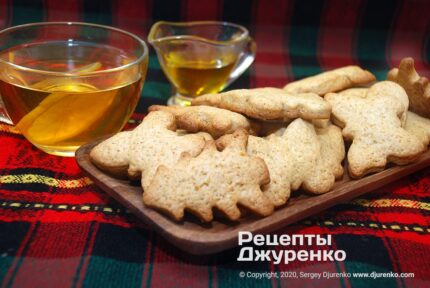
Now comes the most fun part: shaping cookies of all kinds, depending on your imagination and the cutters you have. Cut out the shapes and move them onto a baking sheet lined with parchment. Be careful here: the rolled dough is soft and easily deforms or even tears, so it is best to move the cookies with a spatula or a chef’s knife. The dough will puff up a little in the oven, but the cookies will keep their shape.

Bake the cookies at 180 °C for about 15 mins. Preheat the oven in advance. The cookies can also be baked at 160 or 200 degrees, but the time will differ; I baked at 180. The time may vary with the thickness of the dough. Be careful not to dry out or overbake the dough: as soon as it loses its softness and starts to change color, take the cookies out of the oven and move them to a wooden board. The board must be flat, since hot cookies deform easily.


How to make the icing
Make the icing and decorate the cookies. While the cookies cool, mix powdered sugar with water into a thick paste. For natural colorings you can use beet juice, matcha tea, as for ice cream, blueberry juice and so on. If you like, decorate the cooled cookies as you wish. The icing will set after a short while.
Serving
Serve the ginger cookies well chilled, with tea and lemon or morning coffee. At Christmas I recommend serving the cookies with sweet wine; it is delicious.

If you are visiting, take some cookies along, stacked and tied with a ribbon, as a symbolic gift. Though the cookies can also be just a treat, nice to savor even in the afternoon. And yes, start with the icing, like in childhood. Enjoy!

Calories and macros
475 kcal
100 g
- Protein7.1 g6% of kcal
- Fat20.2 g39% of kcal
- Carbs65.3 g55% of kcal
Calculated from the recipe ingredients, excluding salt and spices. Data: USDA and Matvaretabellen.