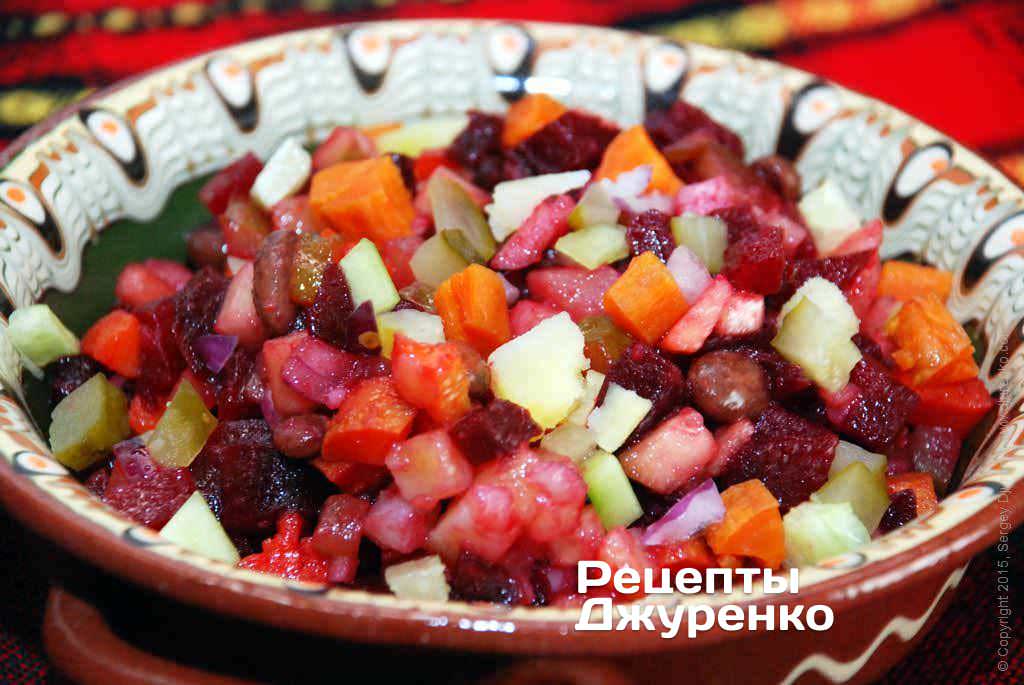
Vinegret Beet Salad
How long do you microwave vegetables for vinegret?
On full microwave power the potatoes for vinegret are done in 8–10 minutes and the carrots in 12–13, while the beets take longer, over 20 minutes. Pierce the beets and potatoes with a knife first, and peel the carrots raw. Take each vegetable out as it is ready, and the whole salad takes 45 minutes instead of an hour of boiling.
Ingredients
4 servings
Step-by-step recipe
Roasting the vegetables in the microwave
Get fresh vegetables, the usual set that’s almost always in the fridge: potatoes, beets, carrots, a fresh cucumber and a salt-fermented (not vinegar-pickled!) cucumber, a sweet onion or a few green onions.
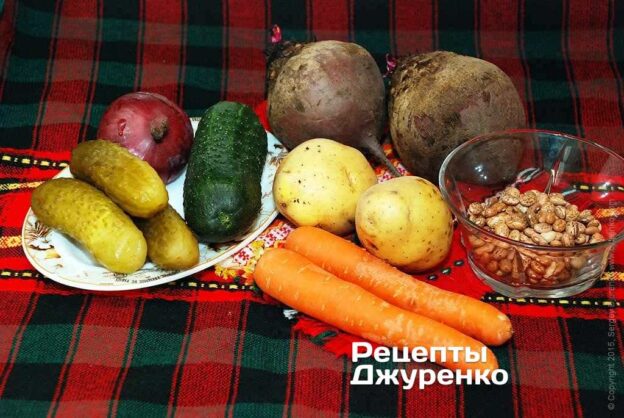
Set the cucumbers and onion aside for now. Wash the potatoes, beets and carrots thoroughly.
The vegetables need to be roasted until fully cooked. The fastest way is in a household microwave.

Pierce the beets all the way through with a thin knife so steam can escape while they cook. Pierce the potatoes with a knife too, in 2–3 places. Carrots are very hard to peel after roasting, so peel them raw, scraping off the top layer with a sharp knife. Pat the carrots dry with a paper towel and rub them with a little vegetable oil, literally a quarter teaspoon.
Lay all the vegetables on a large plate and microwave on full power. The potatoes will be done in 8–10 minutes. It’s easy to check by piercing them with the tip of a thin knife. Take the potatoes out right away and keep cooking the carrots and beets. The carrots will be done in 12–13 minutes. The beets take a bit longer, over 20 minutes.


Chopping
The vegetables cool fairly quickly, even at room temperature.
Peel the cooled potatoes.
Boil the beans; you can replace them with canned peas. Ideally, soak the beans overnight, so they cook well. By the way, you can buy ready-cooked canned beans.
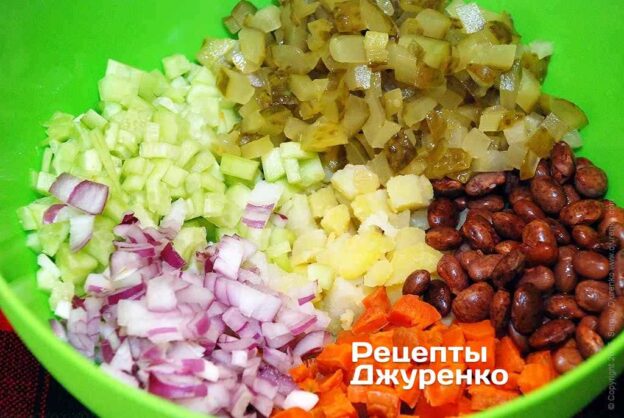
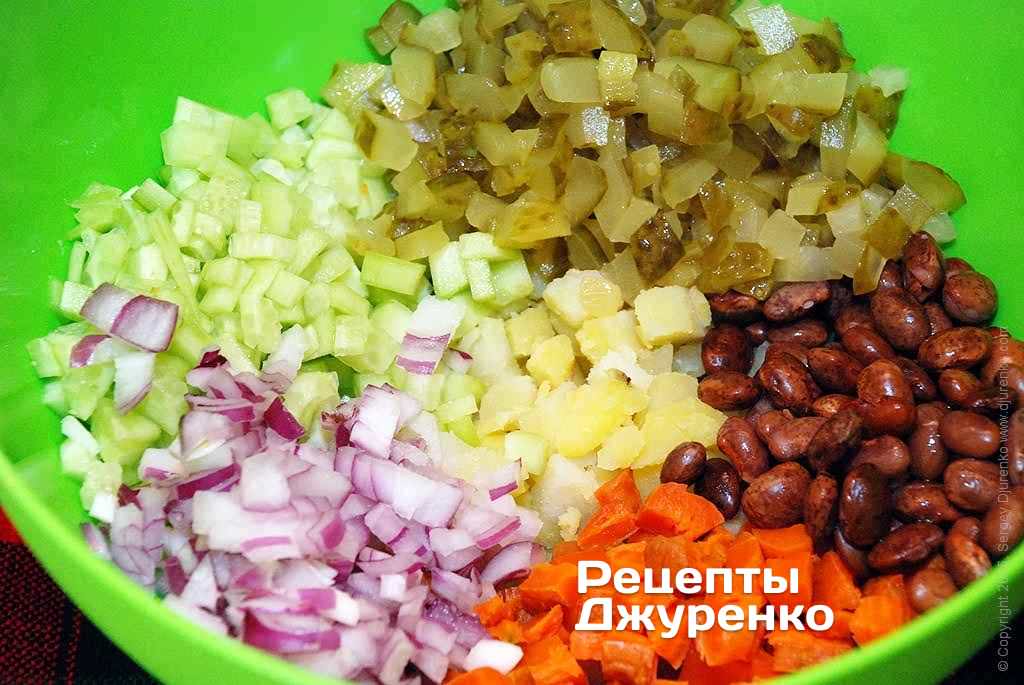
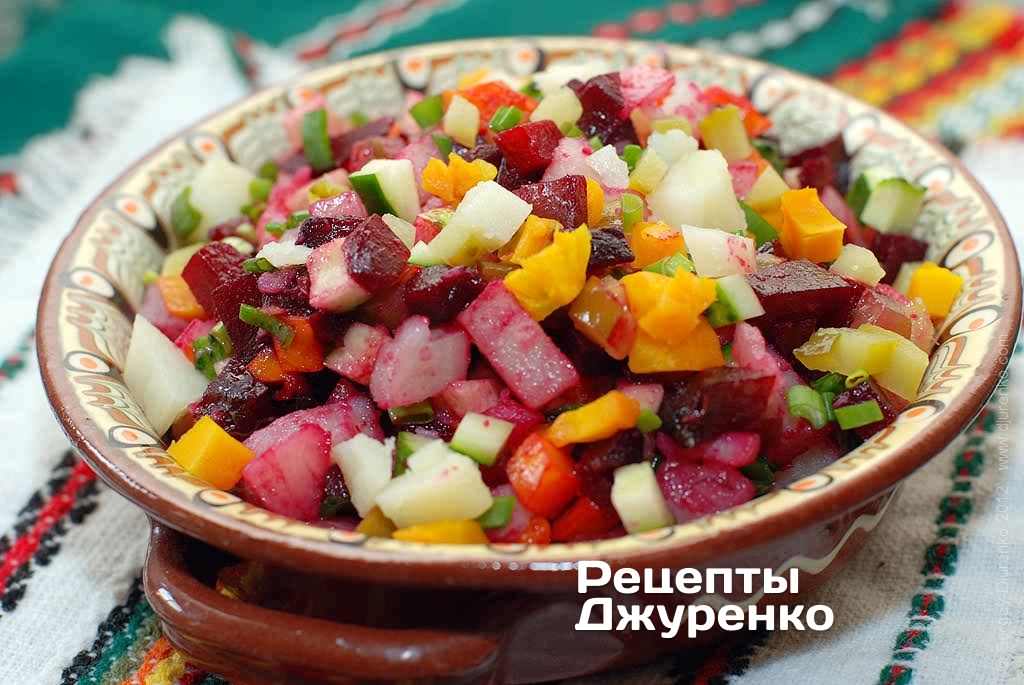
Peel the beets separately, trying not to let them stain the other vegetables. Cut the potatoes and carrots into small cubes. Cut the fermented cucumbers into cubes the same size as the other vegetables. You can replace the cucumbers with sauerkraut; that’s tasty too. Peel and chop the fresh cucumber. Peel and chop the onion, preferably a sweet one. It’s sometimes nice to marinate the onion briefly in just a few drops of wine vinegar. Green onions are also delicious instead of regular onion. Up to you.
Dressing and mixing
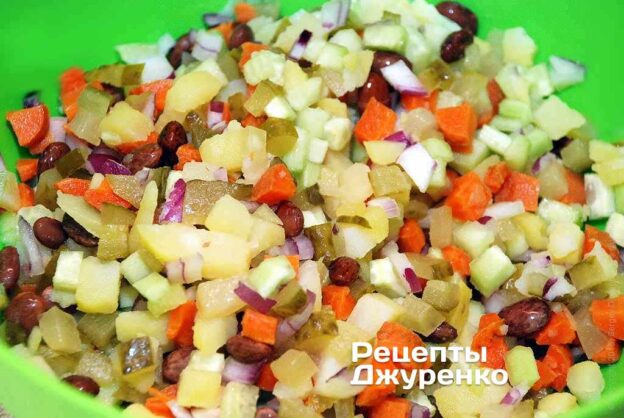
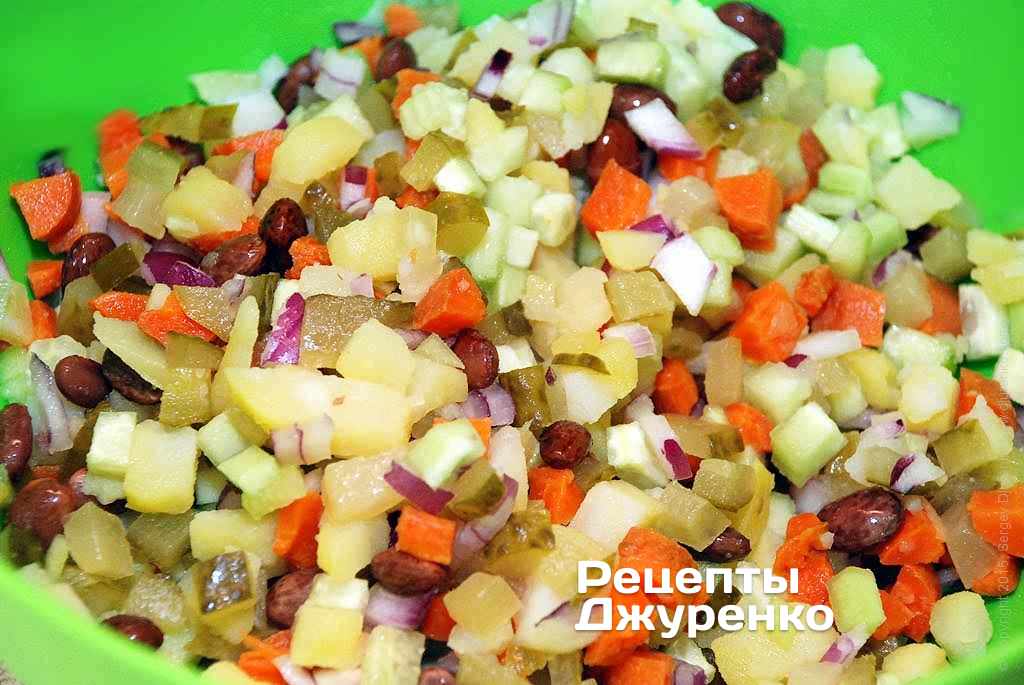
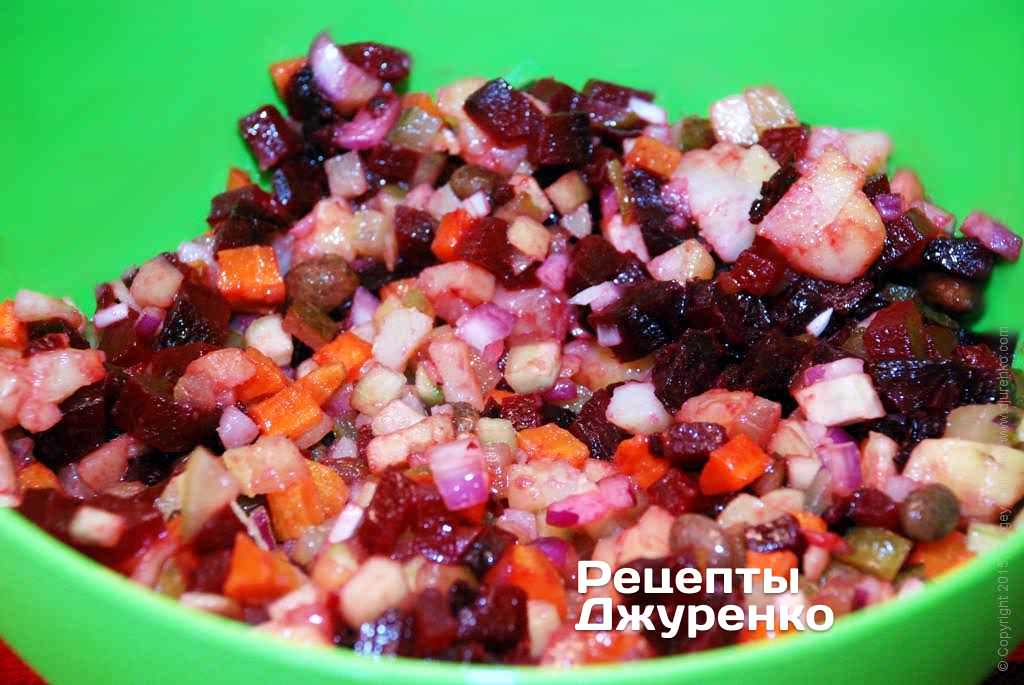
Put all the chopped vegetables and beans in a salad bowl. Season with salt to taste and leave for a short while.
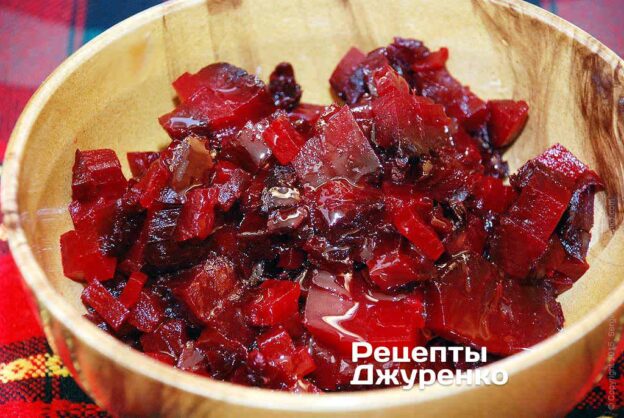
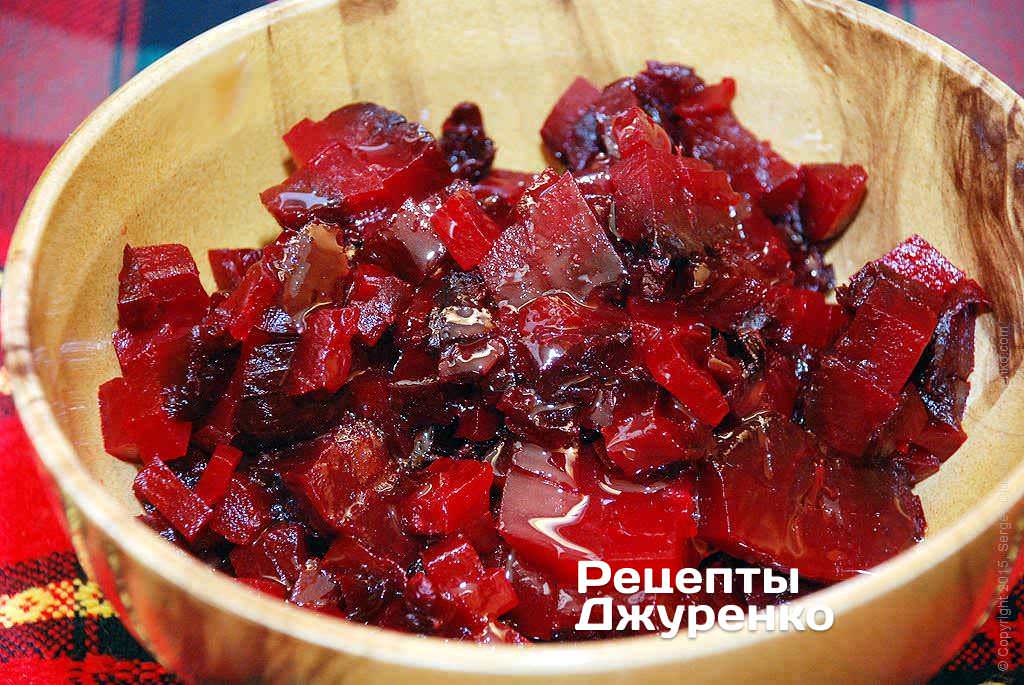
Cut the peeled beets into cubes and put them in a deep bowl. Drizzle the beets with 1 tbsp of sunflower oil mixed with 3–4 drops of wine vinegar. Stir.
First, the film of oil on the beets will greatly reduce staining of the other vegetables. Second, remember that vinaigrette is a sauce of oil and acid (vinegar, lemon).
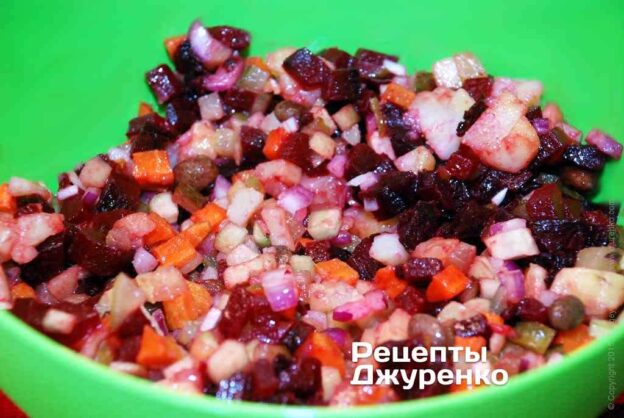
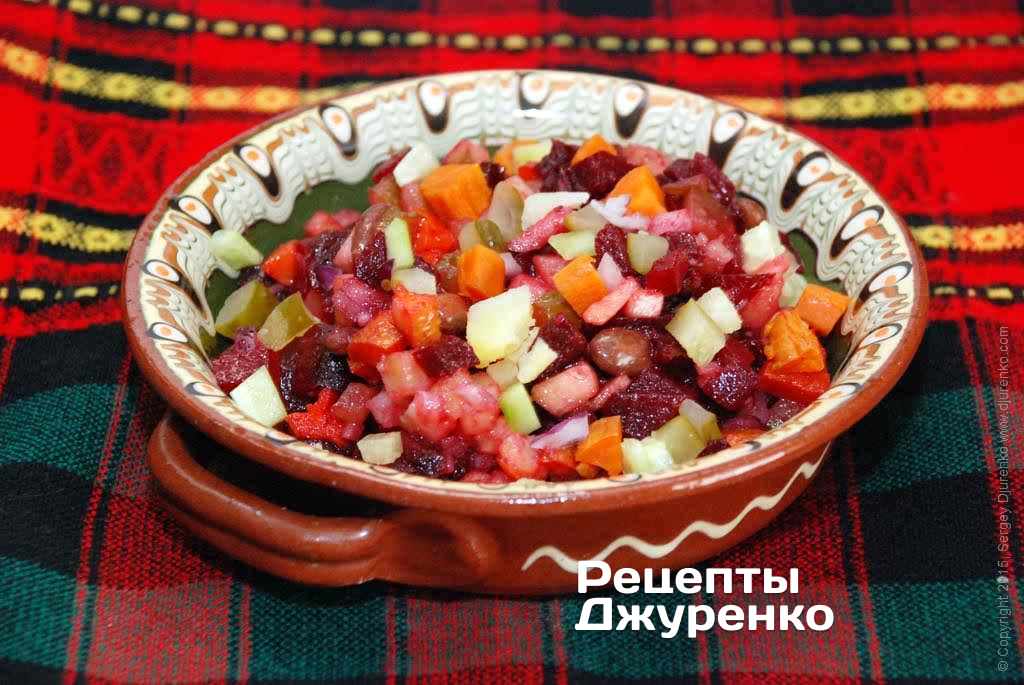
Mix the beets with the rest of the vegetables; you can add more sunflower oil if you like. The salad is delicious right away, while the vegetables are still just slightly warm.
It makes a wonderful, healthy breakfast, lunch and dinner. Well, actually no, there won’t be any left for dinner.

More and more I think that the less time you spend cooking, the tastier the food turns out.

Calories and macros
205 kcal
Serving ≈ 300 g
- Protein7 g16% of kcal
- Fat4 g21% of kcal
- Carbs28 g64% of kcal
100 g69 kcalProtein 2.3 gFat 1.4 gCarbs 9.4 g
Calculated from the recipe ingredients, excluding salt and spices. Data: USDA and Matvaretabellen.
How did you like this recipe?
To Get It Right
If your microwave has no programs
When microwaving vegetables for vinegret, what matters is power, not “temperature”: use full power. A set of vegetables for vinegret weighs about 1 kg. Wash them, lay them on a plate and microwave for 5 minutes, then keep adding 2 minutes at a time and poking the potatoes with a knife until they’re soft. That’s how you find “your” time, and it usually stays the same even with a new microwave.
How to tell the vegetables are done
For vinegret, the potatoes are done first, then the carrots: I take out the ones that are ready to cool and keep roasting the rest. I roast the beets until they start to wrinkle.
Fermented cucumbers, not pickled
Vinegret calls for salt-fermented cucumbers, not ones pickled in vinegar. You can replace them with sauerkraut. The fresh cucumber is my addition to the classic.
A vegan salad
Vinegret has only vegetables, beans and vegetable oil, so it suits fasting days and a vegan table.
Have your own trick for this recipe?
Questions and answers
How do you spell vinegret?
Vinegret, with an “i” after the “v”. Just remember: the word starts with vin, wine. In French, vinaigrette is a sauce of oil and acid, and the salad got its name from it.
How do you make classic vinegret?
Classic vinegret is made from boiled beets, potatoes and carrots with fermented cucumbers or sauerkraut, onion and boiled beans or peas, dressed with sunflower oil. You chop and dress it the same way as in this recipe, only the vegetables are boiled in their skins until tender instead of roasted.
How long to boil beets for vinegret?
Boil the beets whole, in their skins, for about 1–1½ hours, until tender and a knife goes in easily. Potatoes and carrots are done sooner, in 20–30 minutes. In the microwave it’s much faster: the beets take just over 20 minutes.
How do you roast vegetables for vinegret in the oven?
Wrap the washed vegetables in foil and roast at 180–200 °C: potatoes and carrots for about 40 minutes, beets for about an hour; check with a knife. Roasted beets come out sweeter than boiled ones, which is why I stopped boiling vegetables for vinegret long ago.
What is the secret of a tasty vinegret?
Roasted rather than boiled beets: they’re slightly sweet, and the salad tastes simply divine. Also, dress the beets with oil separately so they don’t stain the other vegetables, and eat the salad right away, while the vegetables are still slightly warm.