
Vegetable Risotto
Who knows when somebody first thought of making porridge from cereal grains. I think it was no earlier than the invention of the clay pot.
Only Saltykov-Shchedrin believed that a peasant could cook porridge in his palms. Be that as it may, nowadays cereal porridges are eaten everywhere.
Take oatmeal, for example, the breakfast of athletes and virtuous people, and the “beloved” dish of Sir Henry Baskerville. In Italy the rice porridge is risotto, though it feels awkward to call this wonderful dish a porridge at all. “Little rice” is what the Italians fondly call their favourite rice dish. They make risotto from local rice varieties, round and rich in starch. As a rule, these are Arborio, Vialone Nano, Carnaroli and others.
There are hundreds or thousands of versions and recipes of Italian risotto. The exact composition of risotto is a thing in itself, and everyone decides what to add and when. One thing matters: risotto must be tender, “flowing” and creamy, or, as they say in Italy, all’onda, “wave”. Risotto with seafood is an excellent option.
I think the tastiest risotto is the Venetian one, with raisins and herbs, sprinkled with cheese. I also really like risotto with meat and risotto with strawberries. But to make those you need to have everything at hand, and that does not happen often.
Vegetables, though, are always there. So I decided to make risotto with vegetables. Any home fridge always has, more or less, an onion, garlic, a carrot and a few herbs. Why not make vegetable risotto? As the wise say, every vegetable has its time, so don’t overthink it and combine the ingredients to suit the situation.


Ingredients
2 servings
- Rice (Arborio) 1 cup
(180 g) - Onion 1
- Carrot 1
- Celery stalks 1 stalk
- Garlic 2 cloves
- Green peas 50 g
- Tomato 1
- Parmesan 1 tbsp
(7 g) - Parsley 2-3 sprigs
- Olive oil 3 tbsp
- Vegetable broth or water 500 ml
- Salt, ground black pepper to taste
Step-by-step recipe
Preparing the ingredients
The word “rice” comes from the English word rice, although earlier rice in Europe was called “Saracen grain”. It most likely began in the time of the Crusades. In Kyivan Rus’, rice was called “Saracen millet” in its own way, which sounds much the same. And the biological genus name of rice, Oryza, comes from the Ancient Greek ὄρυζα, or from the Sanskrit vrihi.
Measure out a cup of Arborio rice (180 g). Do not rinse it: it is the starch on the surface of the grains that makes risotto creamy.

Chop the onion quite finely.
Cut the celery stalk into very small cubes, even smaller than for Olivier salad.
Peel the carrot and cut it into larger pieces.
Scald the tomato with boiling water, peel off the skin, remove the seeds and chop finely.

Defrost the green peas.


Simmering the vegetables
In a sauté pan or deep frying pan, heat the olive oil and fry the peeled garlic in it over medium heat until golden, then discard the garlic.

Fry the onion and carrot in that oil until soft. Add salt and pepper. It is better if the onion does not brown, but only turns soft and slightly translucent.

Add the chopped celery and the green peas and stir.

Simmer covered over low heat for 15 mins, until the vegetables are soft.
Add the chopped tomato and stir.

Simmer the vegetables covered for another 5 mins.


Cooking and serving the risotto
Add the Arborio rice, stir and fry over medium heat for 1-2 mins, until the rice is coated with a film of oil and the grains turn translucent at the edges.

Pour in about 500 ml of hot vegetable broth or just boiling water from the kettle. Bring the risotto to a boil.
Cook over low heat, covered, until the rice absorbs all the liquid. If the liquid is absorbed but the rice is still hard, add a little more hot broth. The rice is ready when it is soft outside, with a slight bite inside, usually in 16-18 mins.
Strictly speaking, the liquid in risotto is added in portions, and each next one is poured in after the previous one is fully absorbed by the rice. How you do it is up to you.

Sprinkle the risotto with grated Parmesan and finely chopped parsley and stir right away.

Divide the finished vegetable risotto between plates and serve immediately, while it is hot.


How to make risotto: the essentials
The rice must be round and starchy: Arborio, Carnaroli or Vialone Nano. Never rinse it, because it is the starch on the surface of the grains that makes risotto creamy. Long-grain rice for pilaf or a side dish will not do: you will just get rice with vegetables.
The liquid is hot broth, chicken or vegetable. Cold broth stops the simmering, and the rice cooks unevenly. I most often cook the risotto broth ahead with chicken. For a cup of rice (180 g) you need about 3-4 cups of broth (600–800 ml).
First fry the onion in oil, then the rice for 1-2 mins, until the grains turn translucent at the edges. You can pour in a little dry white wine and let it evaporate. After that, add the broth a ladle at a time, wait until the rice absorbs it, and stir often. The rice is usually ready in 16-18 mins: soft outside, with a slight bite inside.
At the end, take the risotto off the heat, add a piece of butter and grated Parmesan, stir quickly and let it stand for a minute or two under the lid. The Italians call this step mantecatura. Proper risotto doesn’t sit in a mound, but slowly spreads across the plate in a “wave”, all’onda.
All the recipes are collected on the risotto recipes page.
Calories and macros
605 kcal
Serving ≈ 540 g
- Protein11 g7% of kcal
- Fat23 g35% of kcal
- Carbs83 g57% of kcal
100 g112 kcalProtein 2 gFat 4.2 gCarbs 15.4 g
Calculated from the recipe ingredients, excluding salt and spices. Data: USDA and Matvaretabellen.
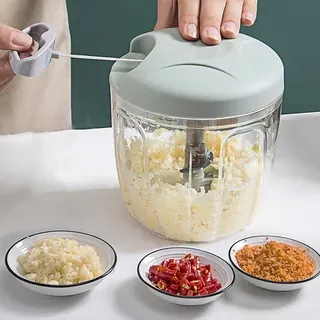 Pull chopper for garlic and onionAliExpress
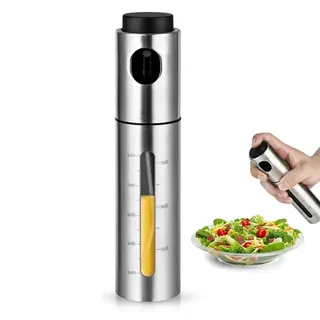 Oil sprayerAliExpress
 Kitchen scale up to 5 kgAliExpress
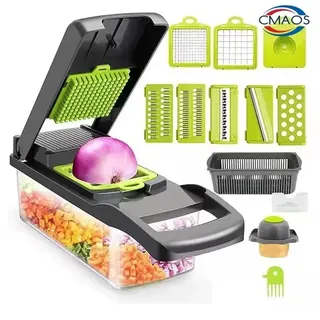 Vegetable chopper with handleAliExpress
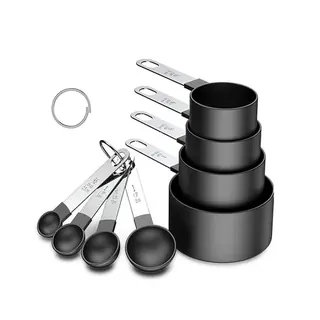 Measuring cups and spoonsAliExpress
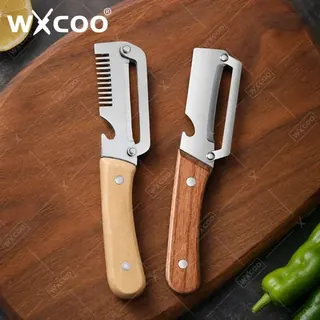 Peeler with wooden handleAliExpress