
Grilled Pork Chop
A pork chop, or a chop from any other meat, is a cutlet. Historically, what we are used to calling a cutlet is not really a cutlet at all. For us, a cutlet is a patty made from ground meat (less often something else), fried on a grill or in breadcrumbs. Yet in fact, a pork chop is much closer to a true cutlet.
In European cuisines, a cutlet is a thin piece of meat cut from a particular part of the carcass (rib, loin, shoulder), a natural cutlet. Only the cooking methods are similar. Côtelette (French) means a rib, something ribbed, that is, a piece of meat with a bone or rib. Our own familiar cutlets are closer to meatballs and croquettes. The fact that the meaning of the name has little to do with the dish does not make our cutlets any worse, depending on your taste.
The situation with the chop is even more confusing. We use the term “breaded cutlet”, or simply “chop”. This meat dish is closer to an escalope, or to a beef chop.
In Europe, the most popular is the Milanese, a unique veal dish prepared in a special way. There are also many variations of similar dishes, and cooks argue until they are hoarse about which one came first: Wiener schnitzel, Milanese cutlet, steak, and so on. In Italy, for example, Wiener schnitzel is called scaloppina alla viennese, and the Milanese cutlet cotoletta alla milanese. And if you look closely, the only difference is the rib bone in the Milanese version. It is like the difference between a beef chop and a steak.
Then there are the common dishes known under the general name “bitochki”. These are, as a rule, small patties of chopped meat, which were at first called chops. They come from French cuisine, where they are called “medallions”; at first they were made from boneless tenderloin and were round. Now the dish has lost its original meaning, and only products made from chopped meat are called bitochki.
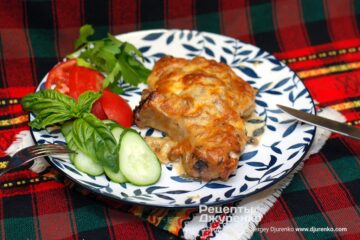
A grilled pork chop: choose and prepare the meat carefully, then cook it to your taste. For a side, we will take just a few plums pickled the Caucasian way.
By the way, a grilled pork chop is an excellent choice for a good picnic.



Ingredients
2 servings
- Bone-in pork chops (250-300 g each) 2
- Dry white wine 100 ml
- Balsamic vinegar 1 tbsp
- Olive oil 1 tbsp
- Coarse salt to taste
- Black peppercorns 4-5
- Ground coriander to taste
- Dried aromatic herbs (oregano, basil, savory, mint) to taste
- To serve
- Soy or Worcestershire sauce 2 tsp
- Fresh herbs to taste
- Pickled plums to taste
Step-by-step recipe
Meat and marinade
For this dish I recommend the cut of pork called the loin. This meat runs along the spine from the shoulder to the sacrum. Each piece should be about the size of a palm, with a piece of rib bone and a little fat along the edge. The meat is cut across the grain, about 2-3 cm thick.

Salt the pieces of meat with coarse salt and sprinkle with ground coriander.
Crush 4-5 black peppercorns in a mortar and sprinkle over the meat. I highly recommend sprinkling with a mix of dried aromatic herbs: oregano, basil, savory, mint.

Arrange the pieces of meat in a single layer in a non-reactive dish and pour over a mixture of 0.5 cup (100 ml) of dry white wine and 1 tbsp of balsamic vinegar. It does not matter if the marinade does not completely cover the meat.

Marinate the meat for 2-3 hours. After a while, simply turn the meat over in the marinade.
Marinating is not a particularly long process, but it greatly improves the flavor of the finished meat and makes it tender. This time I decided to try a new marinade suggested by friends who live on the Apennine Peninsula.
The base of the marinade is dry white wine and balsamic vinegar. Balsamic vinegar is hardly vinegar in the literal sense. It was invented in Italy, in the city of Modena, where it is called “balsamico”. The way it is made is more like making aged wine or cognac. The must of white grapes is boiled down to a thick dark syrup, which is mixed with wine vinegar and aged in oak barrels (or ash, chestnut or cherry). That takes at least three years, and the best balsamic vinegars are aged for 50 years! By the way, the technique of making balsamic vinegar is almost 1000 years old.


Before frying
After marinating, blot the meat with a paper towel to remove any remaining marinade, and discard the liquid.
Lightly pound the pieces of meat with a mallet so that they are no more than 15 mm thick. If you are not sure how much that is, the diameter of a 1 kopeck coin is 15 mm. That saves you from running for a ruler.
Brush the meat with olive oil so that the surface is slightly oily. Use the rest of the oil to grease the grill grate, or, as I do, a grill pan.
Frying
I read somewhere that pork should be fried for 7-8 minutes per 1 cm of thickness. Possibly. For me, a pork chop is done when there is no more pink meat juice inside, which many people take for blood.
From experience, such a chop takes roughly 15-17 minutes in total on a grill pan, 20 minutes at most. On a grill grate a pork chop cooks a little faster because of the higher heat from the burning coals.
Heat the grill and put the pieces of meat on it. I cook at home, so I fry on a grill pan, heated well over medium-high heat. Do not move the pieces of meat while frying, so that a beautiful pattern forms on the surface. The aesthetic enjoyment of food is often as important as its taste.

Fry for 5 minutes, pressing the meat down with a spatula from time to time.
Use the spatula to turn the meat 90 degrees, so that the chop gets a nice crosshatch pattern from the ridged bottom of the pan, and fry for another 5 minutes.
Flip the pieces of meat and fry for 4 minutes, then turn them 90 degrees and fry for another 4 minutes.
In total, the pork chop fries for 18 minutes. After that, see for yourself, you may need to add a little more time. It varies each time, but the meat must be well cooked: there should be no pink juice left inside.


Serving
Transfer the finished chop to a plate and drizzle with 1 tsp of sauce. You can use soy sauce or Worcestershire sauce, a sweet and sour, slightly piquant fermented English sauce. The sauce makes the meat juicier.
You can sprinkle with finely chopped herbs and add a few pickled plums.


Calories and macros
715 kcal
Serving ≈ 240 g
- Protein47 g27% of kcal
- Fat56 g72% of kcal
- Carbs1 g1% of kcal
100 g302 kcalProtein 20 gFat 23.8 gCarbs 0.6 g
Calculated from the recipe ingredients, excluding salt and spices. Data: USDA and Matvaretabellen.
 Meat tenderizerAliExpress
 Kitchen probe thermometerAliExpress
 Pull chopper for garlic and onionAliExpress
 Oil sprayerAliExpress
 Kitchen scale up to 5 kgAliExpress
 Vegetable chopper with handleAliExpress